Wednesday, March 23, 2016

Evolution of Chinese Characters

The Chinese writing system is an unique phenomenon in the modern world of alphabet scripts. Instead of a few dozen letters, it has developed thousands of complex signs or "characters" that represent morphemes and words. Even related writing systems such as Japanese and Korean, while sharing many of the same characters, can fully function as purely phonetic scripts.

The first recognizable form of Chinese writing dates from 3,500 years ago, but many argue that its origins lie much deeper in the past. Regardless of its actual age, Chinese has evolved substantially over time yet has retained its ancient core, making it one of the longest continuously used writing system in the world.

Original

Based on pictographs, Chinese characters combine shapes with sounds and connotations to form unique, block-shaped characters that carry meaning.

The earliest form of Chinese writing is called the oracle bone script, used from 1500 to 1000 BCE. This script was etched onto turtle shells and animals bones, which were then heated until cracks would appear. By interpreting the pattern of the cracks, Shang court officials would make divinations of future events, hence giving the name "oracle bones" to these animal bones.


Stages of Chinese Writing

After the early evolution, the script continued to evolved. Visually it became increasingly more linear, more stylized and less resembling of the natural objects. It also grew in complexity, as the innovations of semantic determinatives (radicals) and phonetic complements continued to be applied to form new words.

Scholars have conveniently divided different styles of Chinese writing into a number of "scripts". The following chart compares different Chinese characters in various forms throughout time. 


The first four phases of Chinese writing trace the first 1,500-year history of Chinese and essentially encompass the evolution from a nascent pictographic and ambiguous writing script to a standardized system containing thousands of characters still in use today.


Influence

As the only indigenous and the oldest writing system in East Asia, the Chinese writing system became the inspiration and the basis for many other East Asian writing systems, some prominent and still in use, while other having faded into obscurity and disuse. Together they are loosely called the Sinitic family of scripts, which includes the following scripts. 


Japanese


At first the Japanese wrote fully in Chinese, but over time the Chine The result is a set of three scripts serving as a single writing system. One of the scripts, kanji is essentially Chinese characters, whereas the other two systems, hiragana and katakana are simplified forms of certain Chinese characters and used exclusively to represent sounds.


Korean


Writing in Korea also started as an adoption of the Chinese script to fit the Korean language, and as a result Chinese characters called hanja came to represent both words as well as sounds.


Khitan


The Khitan people were a powerful Mongolian tribe that dominated Northern China and established the Liao dynasty between the 10th and 12th centuries BCE and invented not one but two scripts both based on Chinese and augmented to their language.  


Vietnamese Chu Nom


means "Southern Writing" and it was a script to write Vietnamese using Chinese character construction principles. What this means is that traditional radicals were paired with characters serving as phonetic components to construct Chu Nom characters that represent Vietnamese words.  


Friday, March 18, 2016

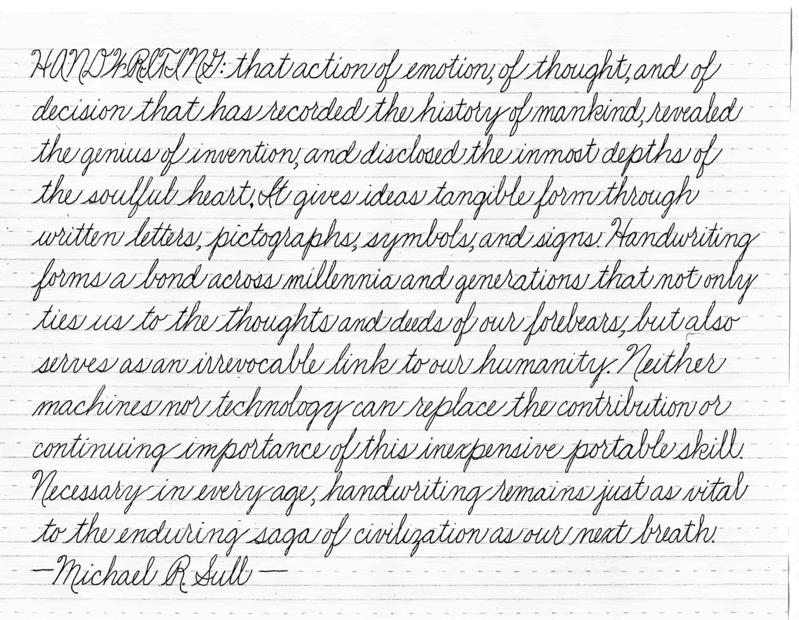
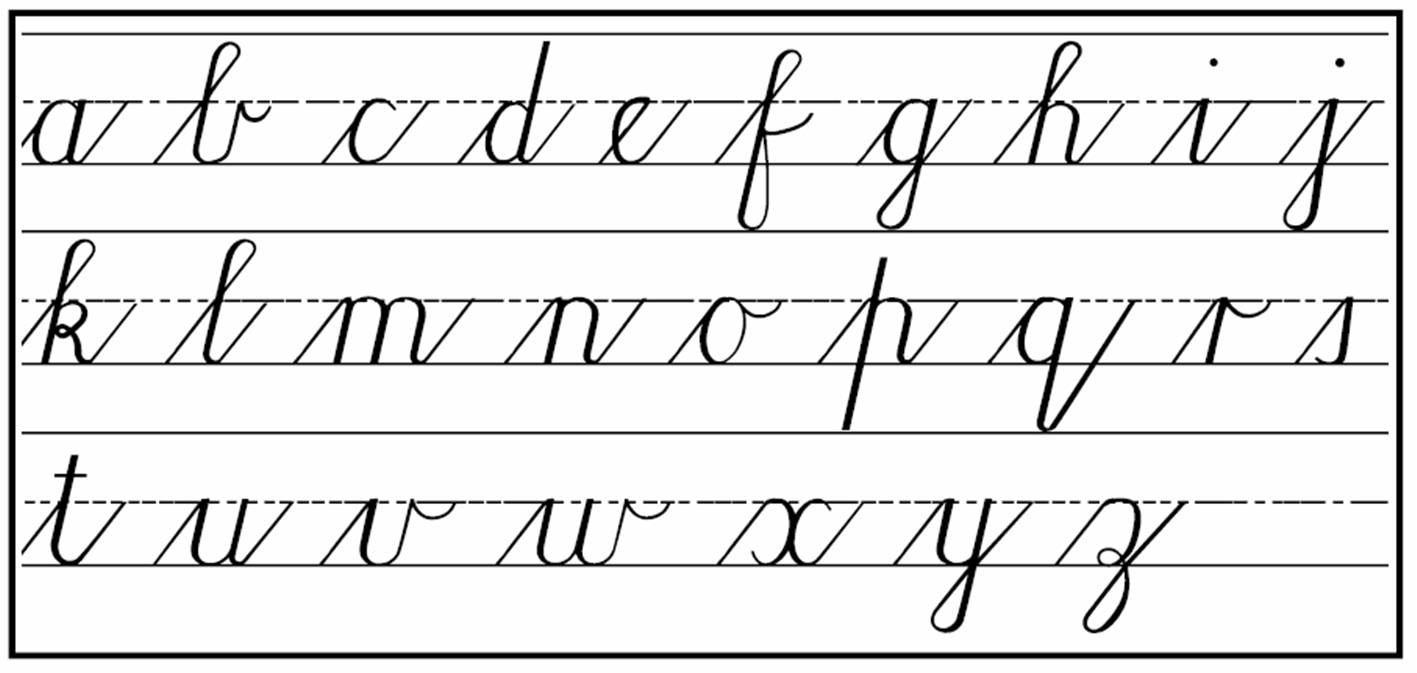
What happened to cursive writing?!

Schools no longer teach cursive hand writing. Instead we see students learning how to write individual letters and in many high schools and universities we see students using their computer to take notes. For many students cursive has become as foreign as Egyptian hieroglyphics. Now, schools have adapted national standards and cursive writing is not included in the program.

One reason for this is that educators seek to prepare students for a future that involves typing skills as opposed to penmanship.  In a way cursive has become obsolete.  It is a traditional skill that has been replaced by technology. Much of teaching time has been consumed with teaching standardized testing. This trend has been slowing declinging since 1970s.

“The truth is that cursive writing is pretty much gone, except in the adult world for people in their 60s and 70s.” - Graham 


"What I typically hear for keeping cursive is how nice it is when you receive a beautifully cursive-written letter. It’s like a work of art,” Graham said. “It’s pretty, but is that a reason for keeping something, given that we do less and less of those kinds of cards anymore?"


According to a 2006 College Board report, SAT essays written in cursive received a slightly high score than those with block print, but only 15 percent of the essays were written in cursive.


Google Doodle


The first google doodle ever made was on August,30,1998. It's only 2 years after the two original creators of the site have built their idea in their Stanford dorm room, and less than a week before Google was even an official company. Larry Page and Sergey Brin went to a Burning Man festival and wanted to show people that they were away, so a stick figure was used to placed behind Google's second "o". This was merely a comical way to show that the founders were "out of office".


Burning Man Festival 1998

Because people loved it so much, Brin and Page decided that they will continue this idea with decorating the company's logo. Dennis Hwang, the (then-intern, now the company's webmaster) was asked in 2000 to draw more. 
Halloween 1999


Halloween 2014


Thanksgiving 1998
First Day of Fall 2015 (Northern Hemisphere) 

Google Doodles are now known for celebrating major holidays, famous artists and scientists around the world. The doodles have become more not only just a still image, but also more interactive through out the years.


Day of the Dead 2015


German Reunification Day 2015

First Day of School 2011 - Estonia, Poland, Russia


Keith Haring's 54th Birthday


Starting in 2014, Google Doodle also started the annual contest called "Doodle 4 Google". This is a competition to have children create a Google Doodle logo for a $30,000 college scholarship, a T-shirt, google chromebook, Wacom digital design tablet, and a $5,000 technology grant of tablets or chromebooks towards their school.

My Best Day Ever... (2013), Winner: Sabrina Brady, Wisconsin, 10-12 grade level

Thursday, March 17, 2016

"An Oasis of Ascenders, Ampersands, and Slab Serifs"


Outside the lovely city of Las Vegas, surrounded by desert, is a typographer's dream. And this dream is The Neon Boneyard; a two-acre Museum which is home to over 250 historic signs. It is home to the most famous signs of Las Vegas, which include: Caesars Palace, Binion's Horseshoe, the Golden Nugget, The Stardust, Palms Casino Resort, New-New York, Lady Luck and O'Shea's.

Each of these signs have been donated or loaned by individuals, businesses or sign companies. The biggest contributor is a major sign manufacturer, YESCO. These ‘boneyards’ would house discarded signage to be used for their source parts or “bones” in the creation of newer, updated signage. As projects grew in scale, the sign makers could no longer house the volume of leftover signs and they began shipping used marquees straight to the dump. An outraged public, the Nevada Arts Council and YESCO stepped in to preserve the neon markers of Vegas past.


The signs' ages range from the 1930's to present day. And these typographic sculptures are tangible history of technology, industry, style, entertainment, pop culture, and most of all: design. You have the to experience of what it feels like to stand beneath a seventy-foot tall initial and to see up close the curves of a signature made of sheet metal. 

 
"It’s hard not to be impressed by the physicality, craft, and art-form in the construction and precise details of every letter. Aside from the craft, you’ll see up-close letterforms that are so unusual, but reflective of an eclectic history that is now only barely captured in design books."

The Neon Museum can be visited 24 hours a day, 7 days a week. You can guide yourself through or sign up for a hour long guided tour.


Sources:
http://idsgn.org/posts/typographic-oasis-the-neon-boneyard/
http://www.neonmuseum.org

https://www.flickr.com/photos/idsgn/sets/72157626625825143/

Friday, March 11, 2016

The Art of Graffiti


Graffiti has been known to be mainly a thing that criminals do to express themselves by spray painting words and images onto walls when they aren't allowed. A lot of the bad publicity about graffiti derives from gangs marking their territory by using graffiti. Lately, graffiti has become an arising and more acceptable art form. The word graffiti comes from the Italian word "graffiato" meaning "scratched." It first arrived in Philadelphia in the late 1960's and spread to New York City in the 1970's. It was revived when hip hop emerged in the 80's.

Letterforms
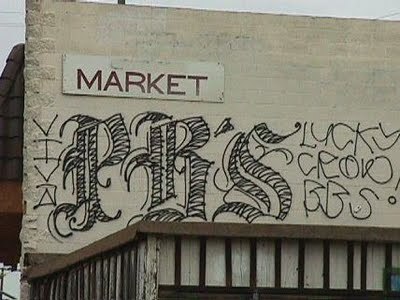
The letterforms in graffiti derived from the simple stroke of a spray paint can to write a simple word, then went to bubble and block letters with shading. Graffiti can be seen as the simple lines, beautifully created letters, or letters intertwined with imagery. As graffiti is looked more and more into as an art form, it becomes more common to see graffiti as well thought out plans that can connect to the setting they are in, such as the art of the famous graffiti artist, Banksy (seen later in post). Many of the letterforms are freehand and do not look like any sort of typeface, but there are scenarios where the letterforms are based on typefaces such as in the picture below. 


Tagging
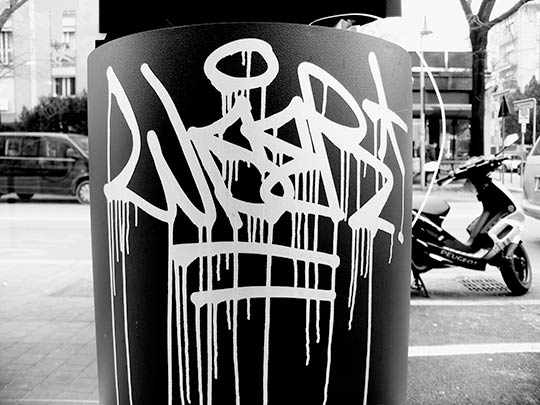
The history of tagging is that graffiti artists would try to create their signature more stylish than anyone else's by using special effects, color, and overall size.


Famous Graffiti Artists
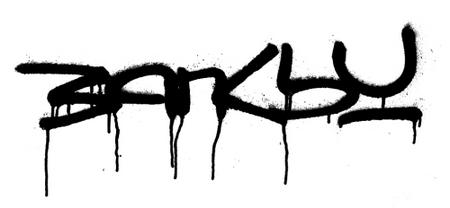
Banksy
Banksy is a European based graffiti artist who paints creative images to interact with the setting of his art.


Sonik
Sonik is an American graffiti artist who mainly tags his name along with other scenery. He was arrested in 2015 for creating 20 tags.


More Creative Graffiti


ScreenshotScreenshot
Screenshot